
Till Human Voices Wake Us
Water has long served as cinema's most mutable metaphor — a medium of transformation, disappearance, and the…
152 min
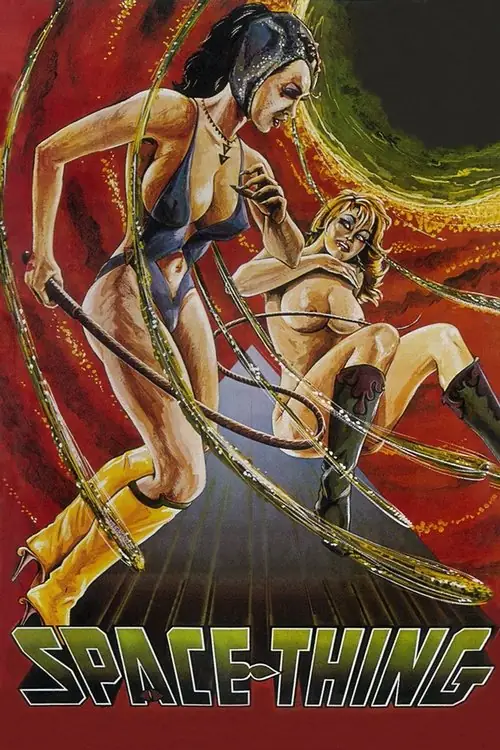
Space Thing occupies a singular niche in the annals of low-budget science fiction — a film that operates simultaneously as pulp adventure, erotic fantasy, and fever-dream allegory, with little interest in maintaining coherent boundaries between those registers. The premise, such as it is, follows a man who falls asleep reading science fiction magazines and dreams himself into an alternate universe where he disguises himself as an alien to infiltrate a spacecraft and prevent an attack on his home world. That the film makes no serious effort to reconcile its dream logic with any rational narrative architecture is, paradoxically, one of its more authentic qualities. The ship's captain is a woman, and the crew dynamics tilt heavily into exploitation-era titillation: lesbian encounters between crew members, disciplinary whippings, and a general atmosphere of sexual availability that reflects the genre's unabashed pandering to its target demographic. Yet there is something about the film's wholesale commitment to its own absurdity that almost — almost — transcends mere sleaze. The dream framework provides an alibi for every narrative non sequitur and tonal lurch, licensing a kind of oneiric anarchy where logic is not violated so much as it is irrelevant. Production values are, predictably, minimal. Sets suggest rather than depict, costumes prioritize exposure over design, and special effects rely on the audience's willingness to meet the film more than halfway. But this very austerity creates a raw, handmade quality that bigger-budget contemporaries often sacrificed on the altar of polish. The spacecraft interiors have a cobbled-together charm, and the alien makeup — however primitive — carries the energy of genuine imaginative effort rather than corporate formula. Space Thing is best understood as a cultural artifact of its moment, a work that crystallizes the peculiar freedoms and limitations of marginal cinema in the 1960s. It is not good by any conventional metric, but it is strange, and in a landscape of homogeneous product, strangeness has its own irreducible value.
Space Thing occupies a singular niche in the annals of low-budget science fiction — a film that operates simultaneously as pulp adventure, erotic fantasy, and fever-dream allegory, with little interest in maintaining coherent boundaries between those registers. The premise, such as it is, follows a man who falls asleep reading science fiction magazines and dreams himself into an alternate universe where he disguises himself as an alien to infiltrate a spacecraft and prevent an attack on his home world. That the film makes no serious effort to reconcile its dream logic with any rational narrative architecture is, paradoxically, one of its more authentic qualities. The ship's captain is a woman, and the crew dynamics tilt heavily into exploitation-era titillation: lesbian encounters between crew members, disciplinary whippings, and a general atmosphere of sexual availability that reflects the genre's unabashed pandering to its target demographic. Yet there is something about the film's wholesale commitment to its own absurdity that almost — almost — transcends mere sleaze. The dream framework provides an alibi for every narrative non sequitur and tonal lurch, licensing a kind of oneiric anarchy where logic is not violated so much as it is irrelevant. Production values are, predictably, minimal. Sets suggest rather than depict, costumes prioritize exposure over design, and special effects rely on the audience's willingness to meet the film more than halfway. But this very austerity creates a raw, handmade quality that bigger-budget contemporaries often sacrificed on the altar of polish. The spacecraft interiors have a cobbled-together charm, and the alien makeup — however primitive — carries the energy of genuine imaginative effort rather than corporate formula. Space Thing is best understood as a cultural artifact of its moment, a work that crystallizes the peculiar freedoms and limitations of marginal cinema in the 1960s. It is not good by any conventional metric, but it is strange, and in a landscape of homogeneous product, strangeness has its own irreducible value.
— Curator's log, recorded 2006±25 BCE
Water has long served as cinema's most mutable metaphor — a medium of transformation, disappearance, and the…

Operating in a register of unbridled creative excess, this audacious genre hybrid reimagines Shakespearean…

Constantin Brâncuși stands as one of the towering figures of modern sculpture, an artist who stripped form…

The American frontier of the 1850s serves as the punishing backdrop for this morally intricate western-horror…