
Till Human Voices Wake Us
Water has long served as cinema's most mutable metaphor — a medium of transformation, disappearance, and the…
152 min
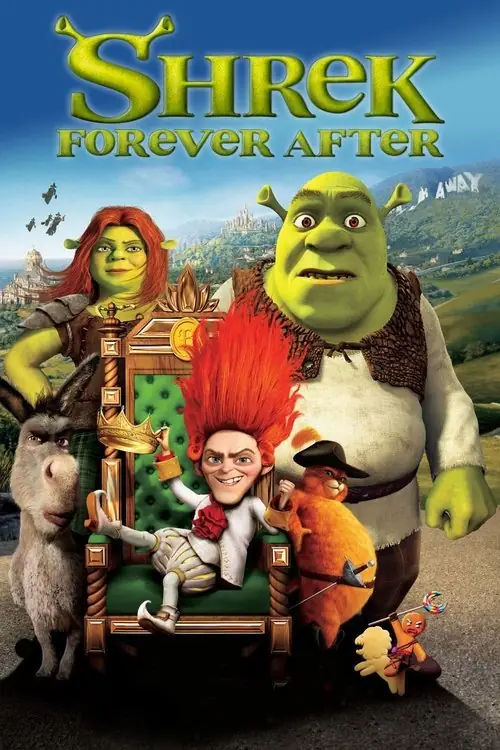
The fourth and most introspective chapter in the saga of animation's most beloved ogre, this film takes a surprisingly poignant approach to its protagonist's existential crisis, transforming what could have been a simple contractual mishap into a resonant meditation on gratitude, identity, and the terrifying ease with which an entire life can be erased from memory. Shrek, now drowning in domesticity and the relentless cheer of parenthood, finds himself pining for the days when his presence inspired genuine terror rather than affectionate tolerance. This yearning for a lost self—mistakenly equated with nostalgia for ogreish menace—is the emotional crack through which Rumpelstiltskin inserts his bargain, and the film's central insight is that what Shrek actually misses is not fear but the feeling of being unequivocally, authentically himself. The alternate-reality Far Far Away that results from the deal is a masterstroke of dystopian world-building, rendering the familiar kingdom as a totalitarian state governed by the diminutive schemer's megalomania. Ogres are hunted, Fiona leads an underground resistance with no memory of Shrek's existence, and the cozy fairy-tale order has been replaced by something resembling an authoritarian regime. This inverted universe allows the filmmakers to revisit signature characters and locations through a darkened lens, generating both comic dissonance and genuine pathos from the audience's knowledge of what has been lost. The animation achieves new heights of expressiveness, particularly in the action sequences that pit Shrek against Rumpelstiltskin's forces—a witches' coven that functions as an aerial military unit is especially inspired, blending fairy-tale iconography with action-movie kinetics in ways that feel both novel and inevitable. The voice performances remain uniformly excellent, with the lead actor locating new shades of vulnerability in a character who had previously been defined by his defensive brusqueness. What gives the film its unexpected emotional weight is the sincerity with which it treats Shrek's journey of reclamation. The lesson he learns—that a life lived authentically among those who love you is infinitely preferable to the solitary freedom of myth—is not delivered as facile moralizing but as a hard-won revelation purchased through the near-loss of everything that matters. The result is a franchise installment that earns its place not through escalating spectacle but through deepening feeling.
The fourth and most introspective chapter in the saga of animation's most beloved ogre, this film takes a surprisingly poignant approach to its protagonist's existential crisis, transforming what could have been a simple contractual mishap into a resonant meditation on gratitude, identity, and the terrifying ease with which an entire life can be erased from memory. Shrek, now drowning in domesticity and the relentless cheer of parenthood, finds himself pining for the days when his presence inspired genuine terror rather than affectionate tolerance. This yearning for a lost self—mistakenly equated with nostalgia for ogreish menace—is the emotional crack through which Rumpelstiltskin inserts his bargain, and the film's central insight is that what Shrek actually misses is not fear but the feeling of being unequivocally, authentically himself. The alternate-reality Far Far Away that results from the deal is a masterstroke of dystopian world-building, rendering the familiar kingdom as a totalitarian state governed by the diminutive schemer's megalomania. Ogres are hunted, Fiona leads an underground resistance with no memory of Shrek's existence, and the cozy fairy-tale order has been replaced by something resembling an authoritarian regime. This inverted universe allows the filmmakers to revisit signature characters and locations through a darkened lens, generating both comic dissonance and genuine pathos from the audience's knowledge of what has been lost. The animation achieves new heights of expressiveness, particularly in the action sequences that pit Shrek against Rumpelstiltskin's forces—a witches' coven that functions as an aerial military unit is especially inspired, blending fairy-tale iconography with action-movie kinetics in ways that feel both novel and inevitable. The voice performances remain uniformly excellent, with the lead actor locating new shades of vulnerability in a character who had previously been defined by his defensive brusqueness. What gives the film its unexpected emotional weight is the sincerity with which it treats Shrek's journey of reclamation. The lesson he learns—that a life lived authentically among those who love you is infinitely preferable to the solitary freedom of myth—is not delivered as facile moralizing but as a hard-won revelation purchased through the near-loss of everything that matters. The result is a franchise installment that earns its place not through escalating spectacle but through deepening feeling.
— Curator's log, recorded 1936±25 BCE
Water has long served as cinema's most mutable metaphor — a medium of transformation, disappearance, and the…

Operating in a register of unbridled creative excess, this audacious genre hybrid reimagines Shakespearean…

Constantin Brâncuși stands as one of the towering figures of modern sculpture, an artist who stripped form…

The American frontier of the 1850s serves as the punishing backdrop for this morally intricate western-horror…