
Till Human Voices Wake Us
Water has long served as cinema's most mutable metaphor — a medium of transformation, disappearance, and the…
152 min
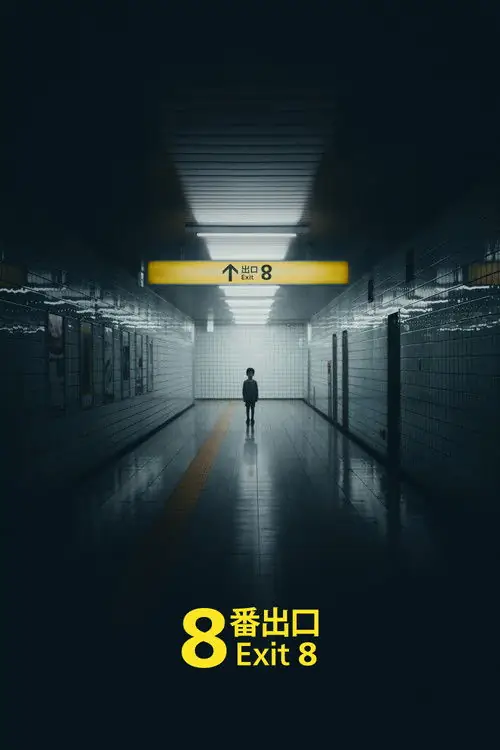
Exit 8 is a claustrophobic thriller that reduces its premise to the most elemental components: a man, a subway station, and the dawning, suffocating recognition that he cannot leave. The film's power derives from this radical simplicity, from the way it transforms a mundane urban environment — the kind of space thousands of people pass through daily without a second thought — into a cage whose walls are invisible but absolute. The protagonist has a mission he must complete to secure his release, but as time passes and his efforts fail, the station's tiled corridors and fluorescent-lit platforms take on the aspect of a purgatory designed specifically for him. The subway station as setting is a masterstroke of economical horror. These spaces are already inherently unsettling: subterranean, artificially lit, designed for transit rather than habitation, they carry an ambient anxiety that the film amplifies with surgical precision. The absence of natural light, the muffled roar of trains that may or may not stop, the institutional architecture that offers no comfort — all of these environmental factors conspire to erode the protagonist's composure and, by extension, the viewer's. The film exploits the paradox of a public space that feels utterly deserted, a place built for crowds that now contains only one man and whatever invisible mechanism holds him prisoner. The protagonist's desperation escalates in a carefully calibrated progression, moving from irritation through frustration to something approaching existential panic. The film resists the temptation to externalize this deterioration through histrionics, instead allowing it to manifest in smaller, more credible ways: obsessive checking of exits, increasingly frantic pacing, conversations with himself that grow less coherent. This psychological realism keeps the premise grounded even as the situation itself resists rational explanation. Exit 8 occupies a space between genre thriller and something more akin to Beckett — a study in confinement, repetition, and the maddening opacity of rules whose logic remains perpetually out of reach. Whether the station is a literal trap or a metaphorical one is a question the film wisely leaves suspended, allowing both readings to deepen rather than cancel each other.
Exit 8 is a claustrophobic thriller that reduces its premise to the most elemental components: a man, a subway station, and the dawning, suffocating recognition that he cannot leave. The film's power derives from this radical simplicity, from the way it transforms a mundane urban environment — the kind of space thousands of people pass through daily without a second thought — into a cage whose walls are invisible but absolute. The protagonist has a mission he must complete to secure his release, but as time passes and his efforts fail, the station's tiled corridors and fluorescent-lit platforms take on the aspect of a purgatory designed specifically for him. The subway station as setting is a masterstroke of economical horror. These spaces are already inherently unsettling: subterranean, artificially lit, designed for transit rather than habitation, they carry an ambient anxiety that the film amplifies with surgical precision. The absence of natural light, the muffled roar of trains that may or may not stop, the institutional architecture that offers no comfort — all of these environmental factors conspire to erode the protagonist's composure and, by extension, the viewer's. The film exploits the paradox of a public space that feels utterly deserted, a place built for crowds that now contains only one man and whatever invisible mechanism holds him prisoner. The protagonist's desperation escalates in a carefully calibrated progression, moving from irritation through frustration to something approaching existential panic. The film resists the temptation to externalize this deterioration through histrionics, instead allowing it to manifest in smaller, more credible ways: obsessive checking of exits, increasingly frantic pacing, conversations with himself that grow less coherent. This psychological realism keeps the premise grounded even as the situation itself resists rational explanation. Exit 8 occupies a space between genre thriller and something more akin to Beckett — a study in confinement, repetition, and the maddening opacity of rules whose logic remains perpetually out of reach. Whether the station is a literal trap or a metaphorical one is a question the film wisely leaves suspended, allowing both readings to deepen rather than cancel each other.
— Curator's log, recorded 1997±25 BCE
Water has long served as cinema's most mutable metaphor — a medium of transformation, disappearance, and the…

Operating in a register of unbridled creative excess, this audacious genre hybrid reimagines Shakespearean…

Constantin Brâncuși stands as one of the towering figures of modern sculpture, an artist who stripped form…

The American frontier of the 1850s serves as the punishing backdrop for this morally intricate western-horror…